The Decomposition model is used to identify underlying components by breaking the series into its component parts and then reassembling the parts to construct a forecast.
Smoothing methods do not focus on identifying individual components of the basic pattern. But many business and economic data contain underlying components that, when examined individually, can help the forecaster better understand data movements and therefore, make better forecasts. Usually, these components include the long-term trend, seasonal pattern, cyclical movements, and irregular fluctuations.
ForecastX™ includes the Decomposition model and presents the detailed information of each underlying component in the Audit Trail report.
To use the Decomposition forecasting technique:
- Click the Forecast Method tab.
- From the Forecast Technique menu, scroll through the list of methods and select Decomposition. The Decomposition Forecasting technique appears.
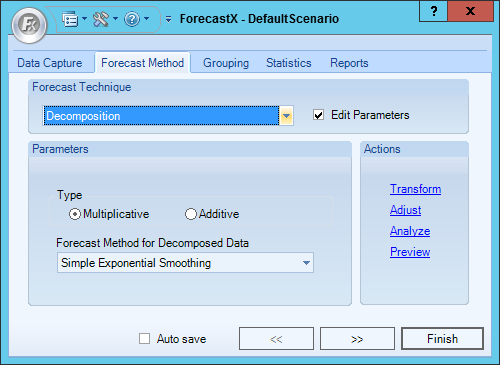
- Enable the Edit Parameters checkbox to activate Decomposition’s parameters. The following table details what each parameter means.
Parameter Description Type Indicate the type of Seasonality of the Decomposition method.
Multiplicative - Seasonality is Multiplicative.
Additive - Seasonality is Additive.Forecast Method for Decomposed Data Select the method used to forecast the long-term trend and cyclical movement in the decomposed data. - Click Finish.
Comments
0 comments
Please sign in to leave a comment.